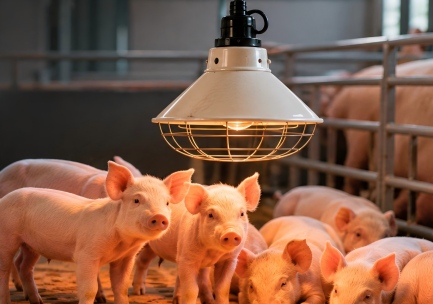
Choosing the right heat lamp wattage for piglets is not simply a matter of selecting the highest-power bulb. Newborn piglets have limited ability to regulate body temperature, while the sow needs a much cooler environment. For this reason, many farrowing systems use a localized heat source to create a warmer creep area without overheating the entire room.
Infrared heat lamps are commonly used for this purpose. Research on commercial swine systems has reported heat lamps in the range of approximately 100W to 250W, with 125W, 175W and 250W being common choices.
The right wattage depends on more than the number printed on the bulb. Room temperature, piglet age, creep area size, lamp height, ventilation and the design of the lamp all affect the actual heat reaching the piglets.
Why Piglets Need a Local Heat Source
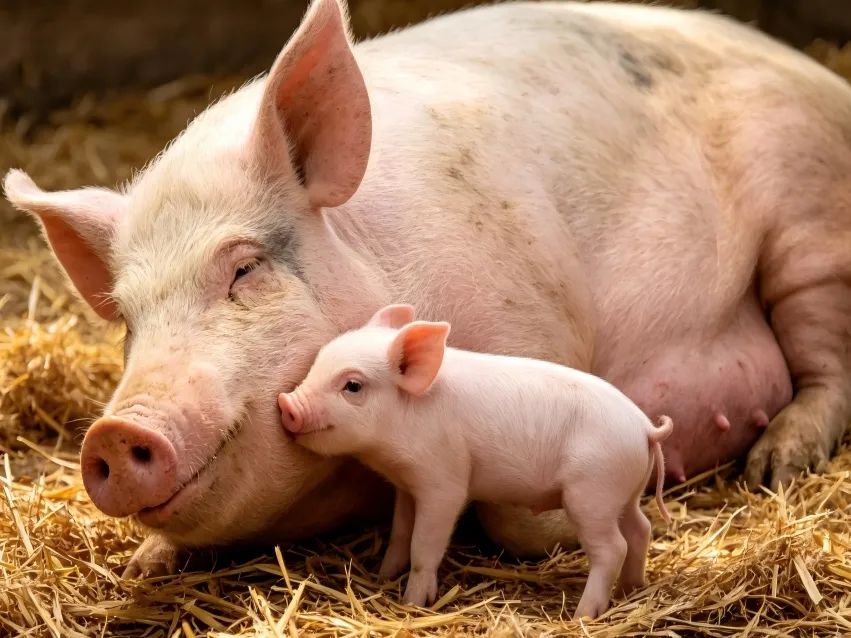
A newborn piglet loses heat relatively quickly because of its small body size and limited thermoregulatory ability. At the same time, increasing the temperature of the entire farrowing room is not practical because adult sows generally prefer a cooler environment.
A better approach is to create a warm microclimate in the piglet creep area. The heat lamp provides radiant heat directly to the floor and the piglets underneath it, while the surrounding room can remain cooler.
Research has reported that recommended piglet microclimate temperatures can be considerably higher than the preferred temperature for sows. This difference is one of the main reasons localized supplemental heat is widely used in farrowing facilities.
Is 100W Enough for Piglets?
A 100W heat lamp can be useful when the heated area is relatively small, the room is already warm, or the lamp is used inside a well-designed creep area that retains heat.However, wattage should not be considered independently from lamp design. Tests of commercially available heat lamps showed that two bulbs with the same rated wattage can produce different heated areas and temperature patterns. The reflector, bulb shape and mounting height all influence how radiant heat is distributed.
For this reason, 100W may work well in some conditions but provide insufficient heat in a cold farrowing room.
When to Consider 150W or 175W
150W and 175W heat lamps provide a useful middle ground for many piglet warming applications.
A 175W infrared heat lamp has been used in commercial farrowing research, with lamps installed about 0.53 m above the creep-area floor and positioned over a defined heated surface. Thermal imaging indicated that the setup provided an adequate microenvironment for the piglets.
The advantage of this wattage range is that it can provide stronger localized heating without automatically creating the large hot spot associated with some higher-power lamps.
A 175W bulb is therefore worth considering when 100W does not maintain the desired creep-area temperature, particularly during colder weather.
What About a 200W Heat Lamp?
A 200W heat lamp for piglets can be considered when additional radiant heat is required but a 250W bulb may provide more heat than necessary for the particular creep area.The important point is to check the actual temperature at piglet level rather than choosing 200W simply because it is between 175W and 250W.
A well-designed 200W lamp installed at an appropriate height may perform better than a poorly positioned 250W lamp. The effective heating area matters just as much as the rated power.
Is 250W Better Than 175W?Not necessarily.A 250W bulb consumes more electricity and can create a stronger heat concentration directly beneath the lamp. That can be useful in colder conditions or larger spaces, but excessive heat can also cause piglets to move away from the heated area.
One Iowa State University comparison reported that 175W lamps used less electricity than 250W lamps and were associated with lower lamp breakage and lower mortality in the conditions studied.
This does not mean that 175W is always the correct choice. It shows why piglet heat lamp wattage should be selected according to the actual thermal environment rather than maximum power.
What About 275W?
A 275W infrared heat lamp is a higher-output option and should be evaluated carefully before being used in a standard piglet creep area.
The commonly reported range for commercial piglet heat lamps is around 100W to 250W, so 275W is outside the range frequently described in the swine research literature.
If a 275W bulb is used, lamp height, reflector design, ventilation and the size of the heated area become particularly important. Simply replacing a 175W bulb with a 275W bulb without adjusting the setup can result in an overly hot spot.
Lamp Height Can Change the Result
Wattage is only one part of the calculation. Heat lamp height can significantly change the size and intensity of the heated area.
In one study comparing commercial lamps from 100W to 250W, changing lamp height affected both the heated area and hotspot area. The researchers also found that lamps with the same wattage did not necessarily produce the same temperature distribution.
This is why farmers should not judge a heat lamp only by its wattage. After installation, measure the temperature where the piglets actually lie and observe their behavior.
Watch the Piglets, Not Just the Thermometer
Piglet behavior is one of the most practical indicators of whether the creep area is comfortable.
If piglets consistently pile directly under the lamp, the heated area may be too cool or too small. If they avoid the center of the heated area and stay around the edges, the heat may be excessive.
The goal is to provide enough warm space for the litter while still allowing piglets to move freely between warmer and cooler areas.
Floor temperature is also important. Iowa State University guidance notes that the floor beneath the lamp for newborn pigs is commonly targeted around 95–100°F (35–38°C), although the appropriate setting depends on the overall thermal environment.
So, Which Wattage Should You Choose?
There is no single best heat lamp wattage for piglets.
For a small or relatively warm creep area, 100W or 150W may be sufficient. A 175W lamp is a commonly used option for localized piglet heating and has been evaluated in commercial farrowing conditions. A 200W or 250W lamp may be appropriate when greater heat output is required, particularly in colder environments or larger areas. A 275W lamp should be used with extra attention to heat distribution and safety.
The practical rule is simple: choose the lowest wattage that can maintain an appropriate piglet microclimate over a sufficient resting area.
A good piglet heating system is not the one that produces the most heat. It is the one that gives newborn piglets a warm, dry and comfortable resting area while allowing them to move away from the heat when they need to.
For farms choosing an infrared heat lamp for piglets, wattage, installation height, heated-area size, bulb construction and electrical safety should therefore be considered together rather than separately.